skip to content

Text size:

News

HomeLatest News

STANDING START

An interview with Sir Frank Williams, head of the Williams F1 racing team, on the benefits of standing.
 

Sir Frank Williams

When a friend gave the young Frank Williams a ride in his Jaguar XK150 in the late 1950s he didn't know what he was starting. In 1966 his young passenger went on to found Frank Williams Racing Cars to compete in Formula Two and Formula Three then, in 1977, together with one of his employees, engineer Patrick Head, he announced the formation of Williams Grand Prix Engineering. Now known as WilliamsF1 and based in Oxfordshire, the same team still competes in Formula One and has had many years of success, winning seven Drivers' championships and nine Constructors championships, making them the third most successful F1 team in history after Ferrari and McLaren.

Rollover lottery

In March 1986 Frank was returning from the Paul Ricard Circuit in France when he had a serious accident, with his car rolling over six or seven times, leading to his sustaining a spinal cord injury and becoming a C6/7 complete quadriplegic. 'What happened was I broke my neck in France and I was in a French hospital for about a week,' he explained. 'I don't remember any of it really, but Professor Sid Watkins, then the Formula 1 doctor, arranged for me to fly back to the London Hospital where he was the senior neurological surgeon. I was there for a while, then I went up to Stoke Mandeville. From there I went home to recuperate, which is what I'd wanted to do in the first place.' Amazingly, by the end of the year Frank was back leading the team he loved into their most successful period.

Since the accident Frank has been confined to a wheelchair. Now Sir Frank Williams, since receiving his knighthood in 1999 for services to motorsport, he explained his condition: 'my level of movement is typical of C6/7 really, which is that I can move my neck very freely and my shoulders pretty freely and I've got reasonable bicep but that's where it stops. I've got no triceps, and my fingers are in a bit of a mess. My breathing's pretty damn good actually for that level. I've had one day off work from having a bit of a cold in 25 years.'

Long distance runner

When Sir Frank suffered his injury doctors pointed out that, based on studies of people with similar problems, he would be lucky to live another 10 years. His ability to carry on, refusing to let his disability affect his day-to-day work, is legendary. But what drove him on? 'I was always very fit,' he explained, 'I did a lot of long distance road running, all my life really, since I left school. I was 43 when I had the accident so after 25 years of pretty serious road running and training I felt the urge to do something that brought me back to some level of fitness. I figured pushing helps the upper body but standing is good for your bones, which get weaker and weaker through lack of use and it was harder to breathe so I figured it would make you stronger and I thought it was a good thing to do. I've been fortunate in never having a pressure sore and hardly spending a day off work through sickness in all that time.

Sir Frank remembers one specific occasion that led to him investigating the possibility of using a standing chair. 'I saw a bloke at the hospital and he spent all his time on his stomach. I thought honestly he'd had the most terrible car accident; his back was ruined with scars and scabs and whenever I saw him he was on his front and I thought what sort of accident did he have? He must have gone off the road at very high speed into railway sleepers, fence or some sort of rigid structure to rip him apart like that. Turned out later they were just simple old pressure sores. I'll never forget that. And that drove me on to getting the first standing chair.'

Relieving the pressure

'I was at the Paddocks Hospital, a clinic connected to Stoke Mandeville, and they made me do physio twice a day to get my limbs all undone – they'd sort of seized up. It was there I saw people using standing chairs. I think by the time I went back for a further three months rehab, within six months of leaving the London Hospital, I bought myself a Levo standing chair and began to try it bit by bit. No turning back. Magic. It was very hard work to start with. But you've just got to do it for five minutes at a time and if it gets all woozy, sit down, and up you go again when you're ready for it ten minutes later.'

It was while at the Paddocks Hospital that Sir Frank first met Gerald Simonds who provided him with the first of many subsequent wheelchairs, for both sitting and standing. Research shows that wheelchair users can be prone to secondary diseases, including pressure sores, which can reduce their quality of life substantially.

Pressure ulcers can be prevented by using pressure relieving cushions and by positioning the user correctly in the wheelchair, but the only position which avoids pressure and has full blood circulation is when standing. There is also good evidence that standing on a regular basis can strengthen the bones. What benefits did Sir Frank notice? 'Just that my breathing was better. I mean I can't tell or feel but obviously if you don't use your bones they begin to waste away, not dramatically but they become more brittle I think, so if I was on my legs for two or two and a half hours a day, I just knew it was good for me. And also being more or less vertical was better for your posture generally,' he continued. 'When you sit in a chair all the time you begin to develop a bit of a tummy, not that your tummy muscles work anymore when you stand up, but it's just better, psychologically. It's psychologically very beneficial as well as physically beneficial and it makes the heart work harder which it should do. It's meant to do that.'

Stand up routine

Sir Frank has a regular routine for standing which fits into his busy home and business life. 'I do slices of 25 minutes, about six a day,' he explained, 'two in the morning before lunch, two in the afternoon before supper, and I always reserve two for watching the telly at night.' He is also aware of the psychological benefits. 'I was always a runner,' he explained. ' I mean if I didn't run a good distance every day I felt unhappy in the evening, so obviously not being able to walk or run at all was quite a psychological setback, but after two or three months being able to stand again was a very big step forward.'

And how do other people react? 'I've never asked, but I've supposed that I look a strange sight standing. I'm aware that people tend to stare at you a bit when you're in a wheelchair but it's not quite the same thing. When you see people standing up in a mobile frame it is very unusual. Wheelchairs are not two a penny but, to quote my friends, they're all over the bloody place these days! But if I was asked if I'd like to meet someone important sitting down or standing up, I'd almost certainly say standing up, providing they get over the first three second shock. I think people find it unusual but actually it's absolutely normal and natural if you think about it. In fact it's bloody marvellous!'

Over the years Sir Frank has had six or seven Levo standing chairs, both electric and manual. With his background, what does he think of them from an engineering point of view? 'Patrick Head, my partner and a great engineer, was a bit blunt but of course he operates a very sophisticated side of engineering; this is practical engineering and its mission is to be successfully comfortable and practical. I got my first electric Levo standing chair in 1987and it still goes. I get it overhauled and get new batteries every few years but it's great. The manual chairs just fold up and I chuck them in the boot almost literally, and pull them out again an hour later. I've got a lighter version that I take when I'm away racing. I've got an electric Levo in the office and a manual one at home.

They do the job. They're lovely.'

Life changer

So finally, how would Sir Frank sum up the benefits of standing? 'The benefits are both physical and mental,' he said. 'Physically it makes your heart work a bit harder and it stretches far more of your muscles. Mentally it's much better to have eye to eye contact in conversations. But it really improves one's health, there's no question about that. It materially helps to avoid pressure sores. I'm preaching a bit but I can't put it strongly enough. There's no question if I hadn't stood I'd have had quite a few pressure sores, like the bloke I saw in hospital. It's been a real life changer.'


GERALD SIMONDS SPONSOR ACES WHEELCHAIR BASKETBALL

Aylesbury-based wheelchair and specialist seating company Gerald Simonds have announced they are to sponsor the Aces Wheelchair Basketball Club.

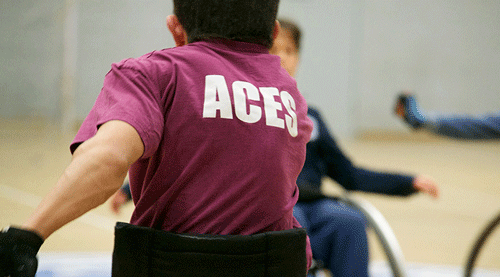
Aces Wheelchair Basketball Club in action

The Aces, one of the UK's largest and most successful wheelchair basketball clubs, are based at Stoke Mandeville Stadium in Aylesbury, birthplace of the Paralympics. They provide the opportunity for people from across the country, with varying degrees of disability, to play wheelchair basketball, encouraging and supporting members of all ages to play for their region or country. Several Aces members are currently in training for the GB team which will compete at the 2012 Paralympics.

Jeremy Strange, Chairman of the Aces said: 'We are delighted that Gerald Simonds are able to support Aces particularly when many clubs are struggling in difficult economic times. We look forward to a long relationship which will help secure the future of wheelchair basketball in Buckinghamshire".

Gerald Simonds Healthcare Ltd. has been supplying and supporting many of the clubs' members, from both the Senior and Junior teams, with their everyday wheelchair needs for many years. Chairman Gerald Simonds said: 'we are now thrilled to be able to support the work of the whole club and look forward to investing in the development of its future.'

The Aces sponsorship deal follows the recent announcement of a partnership between Gerald Simonds and Wheelpower, the British Wheelchair Sports association who own and run Stoke Mandeville Stadium. Both partnerships form the centrepiece of Gerald Simonds' 'Such Good Sports' programme which highlights their strong relationship with wheelchair users both locally and nationwide.


A QUESTION OF SUPPORT

A QUESTION OF SUPPORT

At the beginning of a very exciting year in wheelchair sport, Gerald Simonds Healthcare were proud to mark their association with WheelPower, the British Wheelchair Sports charity, with a sponsorship deal worth £10,000. The sponsorship will support WheelPower, who own Stoke Mandeville Stadium, birthplace of the Paralympic Games, in running the National Junior Games, Inter Spinal Unit Games and Time to Shine Events. Events designed to introduce disabled children and recently disabled adults to the benefits of leading a fit, active life.

Martin McElhatton, Chief Executive of WheelPower, said 'Thousands of men, women and children become disabled due to an accident or illness every year and like many people who are born with a disability, they need to use a wheelchair. We are delighted that Gerald Simonds Healthcare have chosen to sponsor our work which will help transform lives through sport at Stoke Mandeville'.

Gerald Simonds, Chairman of Gerald Simonds Healthcare Ltd. said 'for very many the portal to the world of sport, providing expert guidance, training and world class facilities, will be WheelPower. As a long established supplier of wheelchairs to people with disabilities, whether or not they are actively involved in sport, and as a near neighbour of WheelPower in Aylesbury, I am delighted that my company is able to contribute to the valuable work of this brilliant organisation.'


J3™ Back

WE'VE GOT YOUR BACK COVERED!

The J3™ Back range from Jay has been extended further to provide the most flexible, all in one positioning system they've ever offered. Designed with a variety of contour depths, the J3 Back now includes the new Posterior Deep Contour shape to provide additional support for the lower trunk.

The J3™ Back offers additional support heights and support shapes to fit almost every user, and widths ranging from the new 12" back, for smaller adults, to 26". This incredible range eliminates compromises and guarantees a correct fit almost every time. The variety of options and the multi-adaptable mounting hardware option, now including new, swing-away laterals, means the J3 back can offer virtually every combination of depth, height and width that an adult user may require. And providing the correct size for each individual is critical to preventing problems in the future.

» More about the J3™ Back.

» Contact us for more details or a free demonstration - call us FREE on 0800 220975 for more information.


NEW FreeWheel™ All Terrain Wheelchair Add-On

NEW FreeWheel™ All Terrain Wheelchair Add-On

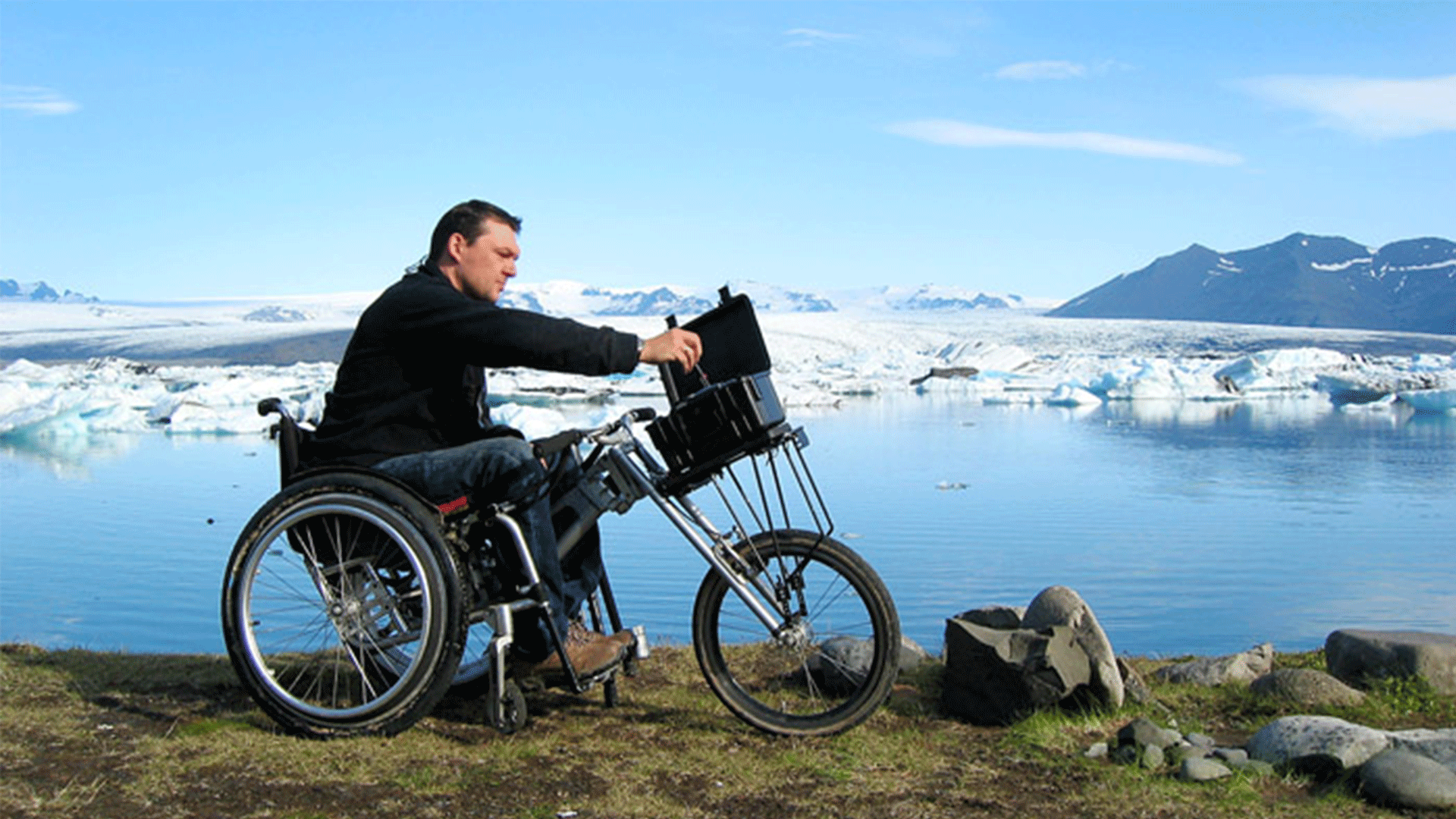
The FreeWheel™ is a rugged, lightweight (under 5lb) add on wheel which quickly clamps simply and securely to the one-piece footrest of your rigid-framed (non folding) wheelchair, allowing you to push over surfaces that would otherwise be difficult or impossible.

FreeWheel™ lifts the front castors off the ground, turning your wheelchair into a sturdy threewheeler that can take you almost anywhere you want to go. Grass, kerbs and rough roads can be easily navigated, giving vastly increased mobility and independence.

Built from strong, aircraft quality aluminium, the patented FreeWheel™ is designed to fit securely on most manual, rigid frame wheelchair footrests, giving a secure fit and excellent handling (footrests higher than 4.5" off the floor will require a custom frame).

The large front wheel has less resistance than small castors and makes it easier to roll on any surface, whether you are alone, or with a companion. A detent mechanism keeps the front wheel straight to improve stability and handling but, by applying slight pressure, it will release, allowing you to turn quickly and easily in any direction.

FreeWheel™ comes complete with an attachment that locks onto the crossbar behind your seat back and holds your FreeWheel™ firmly in place when you need to stow it.

Visit www.gs-direct.co.uk for a special introductory price of only £375, including FREE delivery.


NEW TILITE ZR/ZRA SERIES 2

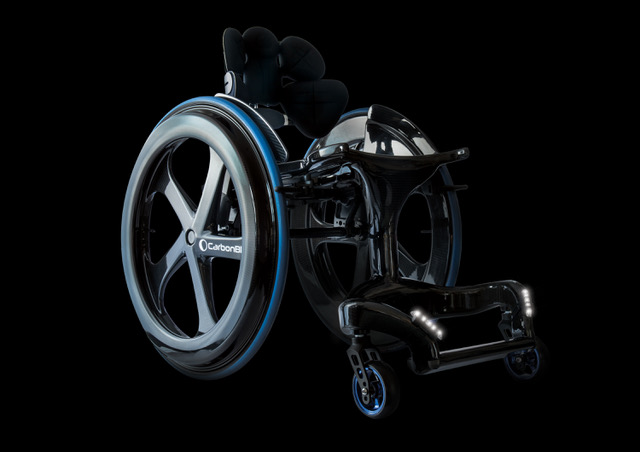
Wheelchairs that perform best combine superb fit with unparalleled quality of construction and the right blend of options. That's the new TiLite ZR and ZRA Series 2, now available from Gerald Simonds.

Don't you owe it to yourself to experience the super smooth ride of a custom-built, perfectly fitted titanium wheelchair? A chair that will perform as well in five years as it does today. Then why not try the new, adjustable ZRA or the outstanding ZR, designed for more experienced users.

The upgraded ZRA's SpeedLoader Adjustable Front Caster Housing quickly and accurately adjusts the fork angle in 1° Increments, while TiLite's Tru-Fit System gives up to 3.5" of rear seat height adjustment.

The SlipStream single-sided fork has an integrated bumper and TiLite's new Performance 5-spoke soft roll wheel weighs just 1.6 ounces, shaving 40% from the weight of the original, 3-spoke wheel. The new Z's 1.25" mono-tube frame is 20% lighter than its predecessor but retains Titanium's 44% strength advantage over 7000 series aluminium. With the new ZR and ZRA Series 2 you have the choice of more options than ever before, including over twenty frame finishes, six colour anodise packages, and titanium tattoos!

The new Z Series. Custom-built in titanium and infused with human energy. Yours.

For more details or a no-obligation demonstration call us FREE on 0800 220975.

Special Offers

special offers We have a selection of new and ex-demonstration wheelchairs and mattresses available at bargain prices.

If you want to visit us for a demonstration or a free assessment, please call us FREE on 0800 220975 to make a convenient appointment.
» View Offers
Phone FREE on 0800 220975
Motability

Visit our you-tube channelVisit our YouTube channel

Find us on facebook

Follow Gerald Simonds on Twitter

Bookmark and Share

View our You Tube channel See our blog Visit our facebook page Follow us on twitter